A summary of my current research interests. I have an observational oceanographic background, but have become increasingly interested in modelling, robotic platforms and data visualisation. I’m currently funded by the OSNAP project.
A summary of my current research interests. I have an observational oceanographic background, but have become increasingly interested in modelling, robotic platforms and data visualisation. I’m currently funded by the OSNAP project.
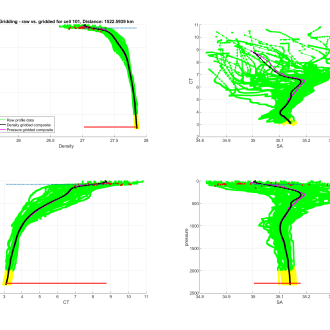
OSNAPi is a conceptual mooring line connecting the German / Canadian western boundary mooring array with the UK eastern boundary moorings. Rather than traverse via east / west Greenland (as for OSNAP), we aim to calculate the central basin transports using a climatology referenced to surface altimetry. It quickly became apparent that existing climatologies did not adequately resolve major currents so I have been developing an improved one, gridding by distance along the OSNAPi line.
Read more An improved historical climatology along the OSNAPi Line

Since 2020, the OSNAP / CLASS robotic glider programme has focussed on maintaining observations of the slope (shelf-edge) current which transports 1-2 Sv of warm, salty water past the UK towards Norway. Conventional moorings were often lost due to fishing so a semi-permanent glider occupation has proved to be the best way of characterising the…
Read more Novel boundary current dynamics characterised by sustained glider observations
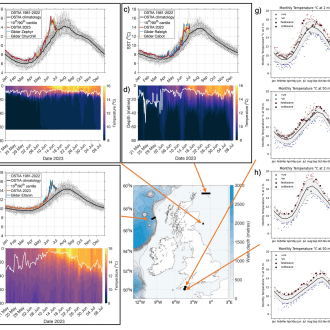
This paper was led by the UK Met Office and breaks down the nature, causes and future likelihood of the extreme marine heatwave to impact UK shelf waters in June 2023. I contributed robotic glider observations illustrating the onset and deepening of the warm surface waters west of the UK.
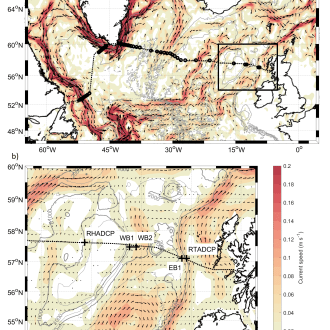
Over the past few years, it has become clear that the eastern subpolar gyre is responsible for most of the AMOC variability captured in the OSNAP mooring line. To try to get to the bottom of this variability, we are looking in detail at the transports reported by moorings across the Rockall Trough.
Read more The role of the North-Eastern Atlantic in AMOC flows and transports

This is work we published in Ocean Science in early 2023. While much has been written on the transformation of water north of the OSNAP or RAPID lines, we decided to isolate and investigate the role of the subpolar gyre interior as delineated by the 1000 m isobath, using a boundary dataset comprised of Argo,…
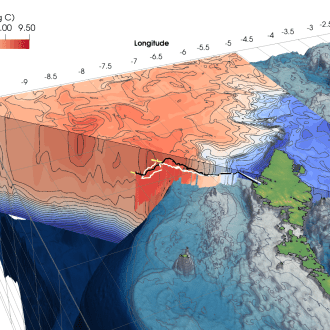
The Navy HECLA project is a continuation of the MASSMO exercises which I have contributed to in the past. It aims to bring underwater and surface autonomous vehicles to an operational level. My role in these exercises is mainly data visualisation, but I’ve also experimented with simple methods for assimilating glider observations into model data.
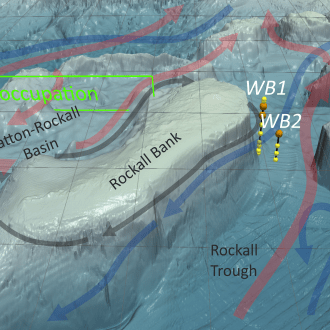
The OSNAP array is an observing system between Scotland and Labrador, Canada which provides continuous measurements of heat and freshwater transport in the North Atlantic Subpolar gyre. These observations allow scientists to track the strength of the Atlantic Meridional Overturning Circulation (AMOC) which exerts a major influence on Northern European and Arctic climate. UK-OSNAP maintains…
Read more Bathymetric controls on the North Atlantic Current – OSNAP
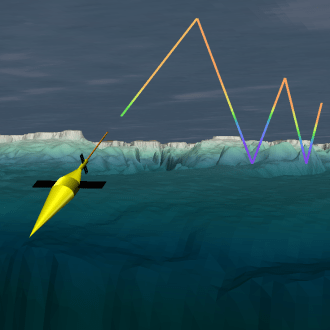
This study was designed to complement the spatial analyses I conducted as part of the ODaT project (see details here) and later as part of MASSMO. Several new data products were computed from historical data, but it was recognised that the occupation of a region by a glider would increase the data density by several…
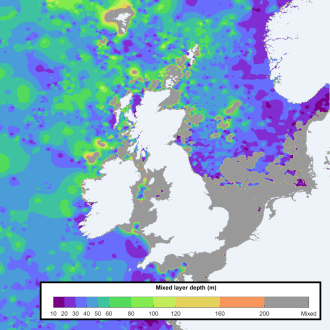
One of the aims of the ODaT project was to generate ‘value added’ data products from existing raw historical data. In collaboration with DSTL, I investigated methods for characterising stratification using both modelled and observational datasets. These products will be distributed on the SAMS geodata server and updated dynamically as new data becomes available. Several…
Read more Experimental spatial analyses using historical data

This work was undertaken as part of the ODaT (Ocean Data Tool) project in collaboration with Marine Scotland. There are millions of historical observations around the UK, but relatively few studies on how they can improve our understanding of local waters. High quality observations of physical properties have taken place for at least 60 years,…

OSNAP is an international program designed to provide a continuous record of the full-water column, trans-basin fluxes of heat, mass and freshwater in the subpolar North Atlantic. The OSNAP observing system consists of two legs: one extending from southern Labrador to the southwestern tip of Greenland across the mouth of the Labrador Sea (OSNAP West),…
Read more OSNAP (Overturning in the Subpolar North Atlantic Program)

This work focuses on the use of Paraview to create an interactive 3D environment to explore oceanographic data. While Paraview is primarily designed for grids and meshes, I have developed scripts and workflows to import common ocean data types including structured and unstructured mesh modelled data, bathymetry, land topography, glider, profiling float, drifting float and…
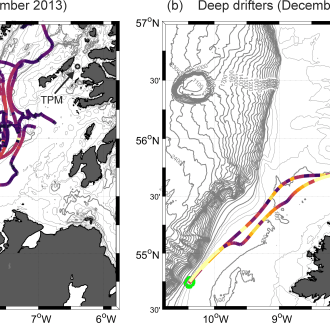
This work is a continuation of my PhD research and combines observations from the Tiree Passage Mooring and a FASTNEt drifter release study. This constitutes a case-study for my wider interest in ocean-shelf interaction between the Atlantic and the Arctic. The drifters were released at the continental shelf edge west of Scotland in summer 2013…
Read more Processes mediating ocean-to-coastline transmission
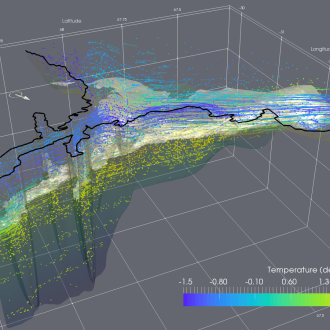
Work completed as part of a publication (Fraser, N., Inall, M.E., Magaldi,M.G., Haine, T.W.N., Jones, S.C. Wintertime Fjord-Shelf Interaction and Ice Sheet Melting in Southeast Greenland. Submitted to Journal of Geophysical Research – Oceans, August 2018.). A model-based study examining the increased melting of Kangerdlugssuaq Glacier and its relation with oceanic incursion into the fjord.…
Read more Wintertime Fjord-Shelf Interaction and Ice Sheet Melting in Southeast Greenland
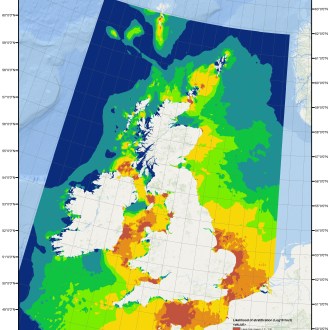
Below is a brief introduction to the rationale behind the ODaT project. For more information on the outcomes and findings, see my pages on temporal analyses, spatial data products and high resolution data products. The outputs of oceanographic campaigns have clear value for the advancement of marine science, but it is important that these benefits…
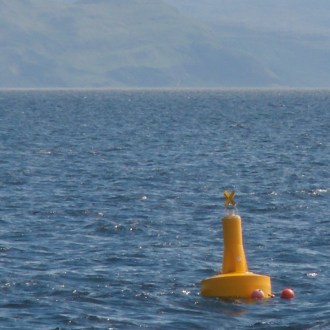
The Tiree Passage Mooring is serviced by staff at the Scottish Association for Marine Science, and represents an invaluable record of the coastal conditions in Scottish waters between 1981 and present. Throughout the years, moorings have regularly been damaged or lost due to winter storms, fouling on fishing trawls or instrument failure, so the mooring…

A short synthesis of my PhD
 Sam Jones